Queensland · Tariffs
How Energex demand charges work for Queensland businesses (2026–27)
On Energex's large business tariff 7200, the network charges your site for the single highest 30-minute demand, in kVA, that it draws between 5pm and 8pm on a weekday, once a month. In 2026–27 that peak demand rate is A$13.913 per kVA per month (excluding GST), plus a smaller shoulder demand charge. One busy half-hour can therefore set a large slice of your power bill for the whole month.
Who is on tariff 7200?
Tariff 7200 (Large Time-of-Use Demand and Energy) is Energex's default network tariff for large business customers in south-east Queensland: sites that use 100 MWh or more a year and have a smart meter. Some older large sites are still on other tariffs, so check the tariff code on your bill. Your retailer passes these network charges through to you. Some bills show them as separate lines; others bundle them into a single rate, which makes the demand charge easy to miss.
The three demand windows
| Window | When | Demand rate (2026–27, excl. GST) |
|---|---|---|
| Peak | 5pm–8pm, weekdays | A$13.913 per kVA per month |
| Shoulder | Weekdays 8pm–11am and 1pm–5pm; weekends 1pm–11am | A$3.672 per kVA per month |
| Off-peak | 11am–1pm, every day | A$0 |
Each window is charged on its own highest half-hour in the month. The peak window is the one that matters: it costs almost four times the shoulder rate.
Why kVA, not kW?
Demand is measured in kilovolt-amperes (kVA), which includes the effect of power factor. At a power factor of 0.85, a 100 kW load registers as about 118 kVA. Sites with a lot of motors, compressors or older equipment can often lower their demand charge with power factor correction before spending anything on batteries. (Where a site's meter data can't support kVA billing, Energex applies a kW version of the charge instead.)
A worked example
A commercial site whose busiest weekday evening half-hour reaches 150 kVA pays about 150 × A$13.913 = A$2,087 for that month in peak demand charges alone, or roughly A$25,000 a year if every month looks similar. Cutting that peak to 100 kVA would save about A$696 a month.
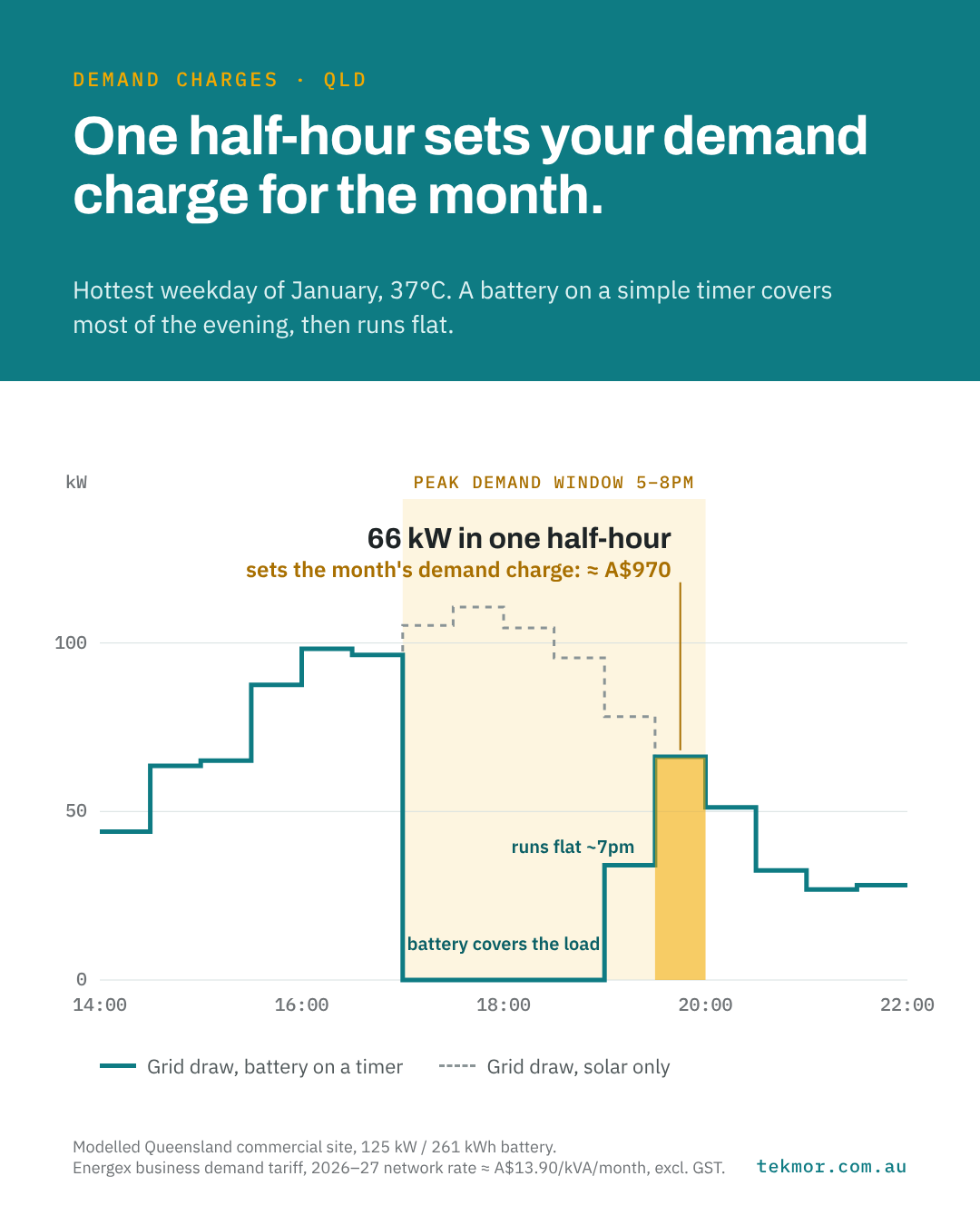
The chart shows why the hardest day decides the bill. A battery set to cover the site's load from 5pm "until empty" does well for two hours. On a hot day it runs flat just after 7pm, the site pulls 66 kW from the grid in the final half-hour, and that one reading sets the charge for the month.
What this means for running a battery
- Charge in the free window. 11am–1pm carries no demand charge and the lowest network energy rate, so it is the natural time to top up from solar and, if needed, the grid.
- Spend energy where it pays. Hold back enough charge for the hardest half-hour of the evening instead of emptying the battery early.
- Plan for the hard days. Forecast the site's load and solar for the day ahead, and adjust before 5pm when the afternoon runs hotter than expected.
- Watch the shoulder windows. Grid charging outside 11am–1pm can lift the shoulder demand charge and eat into the savings.
A well-tuned evening limit on a standard battery controller gets you part of the way. The catch is that the right setting changes from month to month, and each month's charge is decided on its hardest day. That is the gap daily planning closes.
How to check your own exposure
Find the peak demand line on your latest bill, in kVA, and multiply by about A$13.91 to see what your evening peak costs each month. For the full picture, ask your retailer for 12 months of 30-minute interval data (often called NEM12 data). It shows exactly which half-hours set each month's charge, and what a battery, solar or power factor correction would actually change.
Frequently asked questions
Is the Energex demand charge measured daily or monthly?
Monthly. On tariff 7200 the network takes the single highest 30-minute demand in each demand window in the month, and charges for that reading. One busy half-hour in the 5–8pm weekday window sets the peak demand charge for the whole month.
Do weekends count towards the peak demand charge?
No. The peak window is 5pm to 8pm on weekdays. Weekend demand falls into the shoulder window, charged at about A$3.67 per kVA per month, or into the free 11am–1pm off-peak window.
Does rooftop solar reduce my demand charge?
Only partly. In summer, solar can still produce some power after 5pm and trims the evening peak a little. For most of the year output is low or zero by then, so solar on its own rarely moves the peak demand charge much. A battery that is run for the peak window is usually needed to cut it reliably.
Will charging a battery increase my demand charge?
Not if it charges in the 11am–1pm off-peak window, where the demand rate is zero and network energy is cheapest. Charging from the grid in shoulder hours can raise the shoulder demand charge, so timing matters.
How do I find out what my evening peak costs?
Look for the peak demand line (in kVA) on your bill, then ask your retailer for your last 12 months of 30-minute interval data. Tekmor can run a free check from one bill and that data.
Sources
- Amber Electric: Energex Business Tariffs FY2026-27 (tariff 7200 rates and windows)
- Energex: Network Tariff Guide 2026–27 (tariff 7200 eligibility, windows and demand measurement)
Network rates are Energex's 2026–27 rates excluding GST, as published; your retailer's bill may show them differently. Modelled examples are illustrative, not customer data. This article is general information, not financial advice.
See what your site could save.
Send one electricity bill. We'll compare the options and recommend the best-value plan, free.