Queensland · Tariffs
Queensland battery savings: look beyond the network price spread
Three things for business owners
- Some notified half-hours carry high network prices. Keeping energy available for them can matter, but events and savings are not guaranteed.
- Cheap overnight charging can create a demand cost. It does so only if it raises the month's highest demand in a chargeable window.
- Calculate the whole operating plan once. Daily shifting, event readiness and demand control share the same battery; separate savings estimates cannot simply be added.
For a Queensland club, hotel or commercial laundry, a familiar battery strategy is to charge when power is cheap and discharge when it is dear.
Energex's Dynamic Business Tariff Trial shows why that is incomplete as a way to value network charges. Its broader lesson (check the timing of both discharge and recharge) also matters when evaluating other tariffs, though their rates and rules differ. The trial is a network tariff for sites that combine a battery with solar or on-site load. It prices a few short, notified events far more heavily than the everyday evening peak, and it bills demand on separate monthly measures. A battery that follows a fixed daily timetable can miss the most valuable half-hours, or create new costs when it recharges.
What Energex has actually published
The sources are Energex's Expression of Interest (EOI), its notification to the Australian Energy Regulator (AER), and its 2026–27 Network Price List.
Who it is for. The trial extends Energex's earlier storage-only trials to hybrid sites. To be eligible, a site must:
- be a Standard Asset Customer (low voltage) or a Connection Asset Customer (high voltage);
- have an export capacity greater than 30 kW;
- include battery storage together with either on-site generation, such as solar, or a load.
The site also needs a retailer's letter of support, committing to a retail version of the tariff, data sharing and facilitation, unless the customer is itself the Financially Responsible Market Participant for the connection point. Energex keeps the right to include or exclude any customer “at its absolute discretion”.
When it runs. The trial term is scheduled for 1 July 2026 to 30 June 2027. Energex may extend it, amend it on extension, or end it early with reasonable notice. Afterwards, the retailer nominates a standard network tariff. Energex says the learnings will inform a dynamic critical-peak tariff it intends to offer in the 2030–35 regulatory period. Its EOI describes possible submission of a final design to the AER for potential implementation from mid-2030; this is not a confirmed launch date.
All clock times below are Queensland time: AEST (UTC+10), with no daylight saving.
How it charges. The low-voltage and high-voltage versions share these core components:
- a fixed daily charge;
- a peak energy charge on all energy consumed between 5pm and 8pm on weekdays (none on weekends);
- three Critical Peak Pricing (CPP) components, each applied only during notified events: an import charge, an export charge and an export reward;
- a monthly shoulder demand charge, based on the highest 30-minute kW demand in the month during these windows:
- weekdays: midnight to 11am, 1pm to 5pm, and 8pm to midnight;
- weekends: midnight to 11am and 1pm to midnight.
The EOI also lists an off-peak demand charge for 11am to 1pm. The AER notification does not mention it, and the price list shows no rate for it.
How events work. Each CPP event type is capped at 40 hours (80 half-hours) over the trial term. Events can occur individually or concurrently and are charged interval by interval. Notice is by email, with “best efforts” at a day ahead; some events may be unpriced tests. According to the AER notification, import charges and export rewards are expected during high network demand, and export charges during low demand.
The published network rates. For the low-voltage trial tariff (network tariff code 94500), the 2026–27 price list shows these rates, excluding GST:
| Component | Network rate |
|---|---|
| Fixed charge | $9.134 per day |
| Peak charge (weekdays 5pm–8pm) | 2.947 c/kWh |
| CPP import charge | $2.15788/kWh |
| CPP export charge | 17.738 c/kWh |
| CPP export reward | $2.15788/kWh credit |
| Shoulder demand charge | $4.08 per kW per month |
The high-voltage version (code 92500) uses different rates and adds a connection-unit charge ($/unit/day).
Network tariff is not your bill
Energex bills the retailer, not the business, and says retailers are under no obligation to pass its network structures through. A supporting retailer's product could differ in rates or event handling, and retail energy charges sit on top. Model the actual retail offer, not the network price list alone.
What is confirmed, and what is not
As of 9 November 2026, Energex has notified the AER of the two trial tariffs, the AER has approved Energex's overall 2026–27 pricing proposal (22 April 2026), trial rates appear in the published price list, and an application form is online.
We found no public information on how many sites have been accepted, which retailers offer a retail version, or whether any priced CPP events have been called. Energex forecasts small trial revenue (about $70,000 low voltage, $130,000 high voltage). The specific Dynamic Business objective is to evaluate whether hybrid sites can deliver network benefits comparable to storage-only sites, including peak reduction, solar absorption and DER flexibility.
Treat it as a time-limited trial with discretionary entry, not a tariff any business can simply switch to.
Why the network price spread is not enough
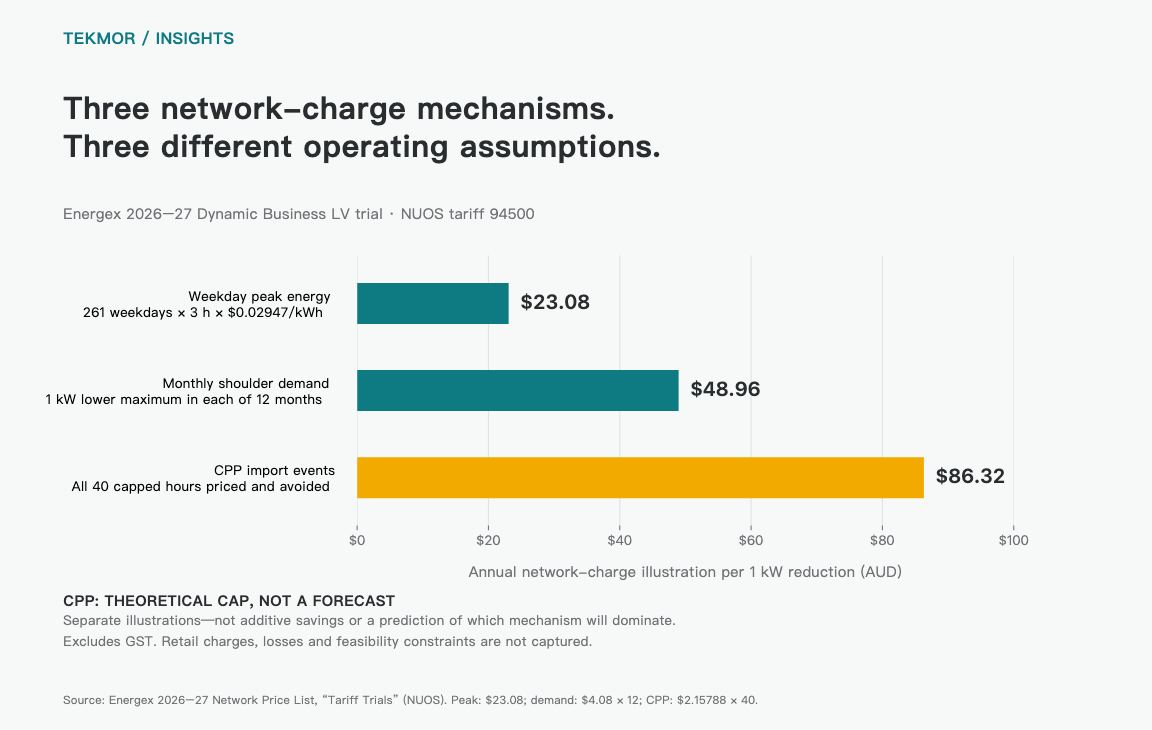
On these published rates, the everyday evening peak charge is the smallest lever. Removing 1 kW of import from every weekday 5pm–8pm window for a year is worth about $23 in network charges. That is roughly 261 weekdays × 3 hours × 2.947 cents (public-holiday treatment not confirmed).
Under the following separate assumptions, two other network-charge illustrations are larger:
- Shoulder demand. Holding monthly shoulder demand 1 kW lower all year is worth $48.96.
- CPP import events. If every one of the 40 capped hours were called, and the battery avoided 1 kW of import in each, the network saving would be about $86.
That last figure is a ceiling, not a forecast. These figures illustrate different charging mechanisms, not a universal ranking of realised savings. High-priced event half-hours are notified, potentially at short notice, rather than fixed in advance. A battery emptied on a routine schedule may have nothing left for them.
Retail energy charges also matter. An illustrative incremental retail spread of 10c/kWh across 783 evening hours gives $78.30 per 1 kW shifted before losses and other costs. That is not a typical rate claim or a net saving. If the retail spread already includes network charges, do not add those network savings again. Use the actual retail offer and one combined dispatch.
There is also a potential cost. Shoulder demand covers overnight hours and weekend evenings. Recharging from the grid at night, or running empty before a busy late session, can set a new monthly demand peak.
Where the signals pull against each other
For a hybrid site, the signals compete for the same stored energy and inverter capacity.
- Event reserve versus daily cycling. Energy used for routine shifting is unavailable if an import event is called. Without guaranteed notice, the controller needs a reserve policy, which costs something on days with no event.
- Export reward versus site load. The reward pays only for energy actually exported. A 100 kW battery at a site drawing 200 kW can only reduce import; earning the reward needs discharge power above site load and a connection that permits export.
- Export charge versus solar soak. Export-charge events are expected at low network demand, which is likely to include sunny middays. A full battery then means paying to export surplus solar or curtailing it.
- Recharging versus demand windows. The 11am–1pm window has no priced demand charge in the price list (an unresolved point), but lasts two hours. At an assumed 100 kW charge limit, a battery can take at most 200 kWh of AC charge input in it, and losses mean restoring 200 kWh of usable energy needs more. The remaining energy needs solar or grid charging outside that window. Shoulder-window charging raises the billed demand only if it sets a new monthly maximum; weekday 5pm–8pm grid charging adds peak energy charges. The charge limit applies to the battery, not site load.
Evaluate these mechanisms in one constrained dispatch and avoid double-counting. Import reduction can also reduce billed demand when windows and tariff rules allow. But the same metered energy cannot simultaneously be an import reduction and an export; power, energy and connection limits still apply.
A hypothetical example
This hypothetical event-day example compares selected network charges plus incremental monthly demand, not a full bill, net saving or payback. All site, battery and event parameters are assumed. Published low-voltage rates are passed through one-for-one, excluding GST.
Assumptions:
- Battery: 100 kW / 200 kWh usable, 90% round-trip efficiency, with an assumed 100 kW charge limit. Both strategies start the day full.
- Evening load: a steady 200 kW import, 5pm–8pm on a weekday.
- Event: a CPP import event from 6pm to 8pm, notified a day ahead.
- Rest of the month: the highest shoulder demand is otherwise 150 kW, and overnight load is 70 kW.
- Charge stacking: the CPP import charge applies on top of the peak charge.
- Off-peak demand: no additional 11am–1pm demand charge is included; this is an unresolved term, not a confirmed exemption.
- Excluded: the fixed daily charge; the base shoulder demand charge on the first 150 kW (identical in every case); recharge energy costs; the opportunity cost of solar used for charging; battery capital and O&M costs; and any off-peak demand charge that may apply.
No battery. Peak charges are 600 kWh × 2.947c = $17.68, and event imports are 400 kWh × $2.15788 = $863.15. Selected charges total $880.83.
Strategy A: a fixed spread schedule. The battery discharges evenly from 5pm to 8pm at about 66.7 kW, then recharges from the grid at 100 kW after midnight, on top of the 70 kW overnight load.
- Peak charges: 400 kWh × 2.947c = $11.79.
- Event imports: 133.3 kW × 2 hours = 266.7 kWh × $2.15788 = $575.43.
- Incremental demand: overnight recharging lifts shoulder demand from 150 kW to 170 kW, adding 20 kW × $4.08 = $81.60 for the month.
- Selected charges: $668.82, a reduction of $212.01 against no battery.
Strategy B: event-aware dispatch. The battery holds its charge until 6pm, then discharges at 100 kW through the event.
- Peak charges: still 400 kWh × 2.947c = $11.79.
- Event imports: 100 kW × 2 hours = 200 kWh × $2.15788 = $431.58.
- Incremental demand: none, provided recharging does not set a new shoulder maximum above 150 kW.
- Selected charges: $443.36, a reduction of $437.47 against no battery.
| Selected charges (event day + monthly demand increment) | No battery | A: fixed schedule | B: event-aware |
|---|---|---|---|
| Peak energy | $17.68 | $11.79 | $11.79 |
| CPP event imports | $863.15 | $575.43 | $431.58 |
| Incremental shoulder demand | – | $81.60 | $0 |
| Total | $880.83 | $668.82 | $443.36 |
What explains the difference? Using unrounded calculations, B reduces these selected charges by $225.46 relative to A:
- $143.86 from discharge timing: event imports fall from 266⅔ kWh to 200 kWh, at $2.15788/kWh. Both strategies have the same peak-energy charge.
- $81.60 from the assumed recharge path: A sets a new 170 kW monthly shoulder maximum; B avoids the 20 kW increment above the otherwise 150 kW maximum.
This decomposition is conditional: a dispatch-only comparison would hold recharging constant. B needs a feasible recovery path without a new shoulder maximum; both decisions share battery constraints. Calculations use unrounded values, so subtracting rounded line items can differ by one cent.
For B, next-day midday solar plus an 11am–1pm grid top-up is illustrative, not guaranteed. Other grid charging increases billed shoulder demand only if it sets a new monthly maximum; weekday 5pm–8pm charging adds peak energy charges.
Both strategies discharge 200 kWh and need about 222 kWh of AC recharge input. Neither exports. Results change with event timing, notice, load and retail pass-through.
Model size, control and forecast risk together
Owners, EPC contractors and investors should expect a model to cover:
- kW and kWh separately. Power limits how much import can be offset and whether export is possible; energy limits how long an event or demand cap can be held. Size both on 30-minute interval data.
- Losses and throughput. Include round-trip losses, auxiliary loads and cycling degradation, and check warranty throughput limits against the actual dispatch strategy.
- Forecast error. Test wrong forecasts of load, solar and event timing, including late notice and unpriced tests.
- Connection constraints. Confirm the export limit and connection agreement. The more-than-30-kW export capacity requirement is an entry condition, not permission for any particular export.
- Fallback behaviour. Define what happens if communications fail, an event email is missed or the trial ends early, and compare against the standard tariff that would apply afterwards.
- One combined dispatch. Model all value streams in one constrained dispatch rather than adding up separate estimates.
What this means for Queensland sites
The trial signals possible future network pricing; it is not an offer open to every business.
A site with a large evening load and limited export may get most of its value from avoiding imports and controlling demand; one with surplus solar and export headroom may have a real export case. Only the site's own data, modelled against its retail offer, can tell.
Tekmor is an Australian company focused on commercial solar and battery energy management. If you are assessing a battery or reviewing a proposal, send us 12 months of 30-minute interval data, a recent bill, your connection details and your retail tariff. We can review the numbers against your data and tariff, and tell you plainly what can be modelled today and where the uncertainty sits. This article is a worked analysis of published rates, not a product demonstration.
Related: How Energex demand charges work for Queensland businesses (2026–27).
Frequently asked questions
Can any Queensland business switch to the Energex Dynamic Business tariff?
No. It is a time-limited trial, scheduled for 1 July 2026 to 30 June 2027, for low- and high-voltage sites with an export capacity greater than 30 kW and battery storage combined with solar or on-site load. Entry needs a retailer's letter of support, unless the customer is its own Financially Responsible Market Participant, and Energex can include or exclude customers at its absolute discretion.
How much is a Critical Peak Pricing import charge on the trial?
On the low-voltage trial tariff (network tariff code 94500), the 2026–27 price list shows $2.15788 per kWh excluding GST, applied only during notified events. Each CPP event type is capped at 40 hours over the trial term, and notice is by email, with best efforts at a day ahead.
Can charging a battery overnight increase my network charges on this trial?
It can. The shoulder demand charge ($4.08 per kW per month on the low-voltage trial) is based on the highest 30-minute kW demand in the month across windows that include overnight hours. Grid recharging that sets a new monthly maximum raises the charge; recharging that stays below the existing maximum does not.
Is the network price list the same as my electricity bill?
No. Energex bills the retailer, not the business, and retailers are under no obligation to pass its network structures through. Retail energy charges sit on top, so a battery business case should model the actual retail offer.
References
All sources were checked on 9 November 2026.
- Energex, Expression of Interest – Dynamic Business Tariff Trial (including Terms and Conditions)
- Energex, 2026-27 Network Tariff Notification – Tariff Trial Notification (February 2026), published by the AER
- Energex, 2026-27 Network Price List (“Tariff Trials” sheet; rates exclude GST)
- Energex, 2026-27 Pricing Proposal Overview (section 2.3, Trial tariffs)
- AER, Energex – 2026–27 pricing proposal: Decision (approved 22 April 2026)
- Energex, Network tariffs & pricing (trial overview, price list, EOI and application form; retailer pass-through statement)
- Energex, 2026-27 Network Tariff Trial Application Form
This article is general information, not financial or tariff advice. The worked example is hypothetical. Trial terms, eligibility and rates are set by Energex and may change. Confirm the current position with Energex and your retailer before making decisions.
See what your site could save.
Send one electricity bill. We'll compare the options and recommend the best-value plan, free.